Deep Brain Stimulation Center
ㅤ
Azur DBS is a center dedicated to the care of patients eligible for Deep Brain Stimulation.
Deep Brain Stimulation (DBS) is a technique that involves implanting leads in the brain, connected to a neurostimulator, to improve the symptoms of certain neurological diseases: Parkinson's disease, essential tremor, dystonia…
Deep Brain Stimulation (DBS)
What is Deep Brain Stimulation?
This is a surgical procedure that involves implanting a device that sends signals to the brain to help control the symptoms of movement disorders.
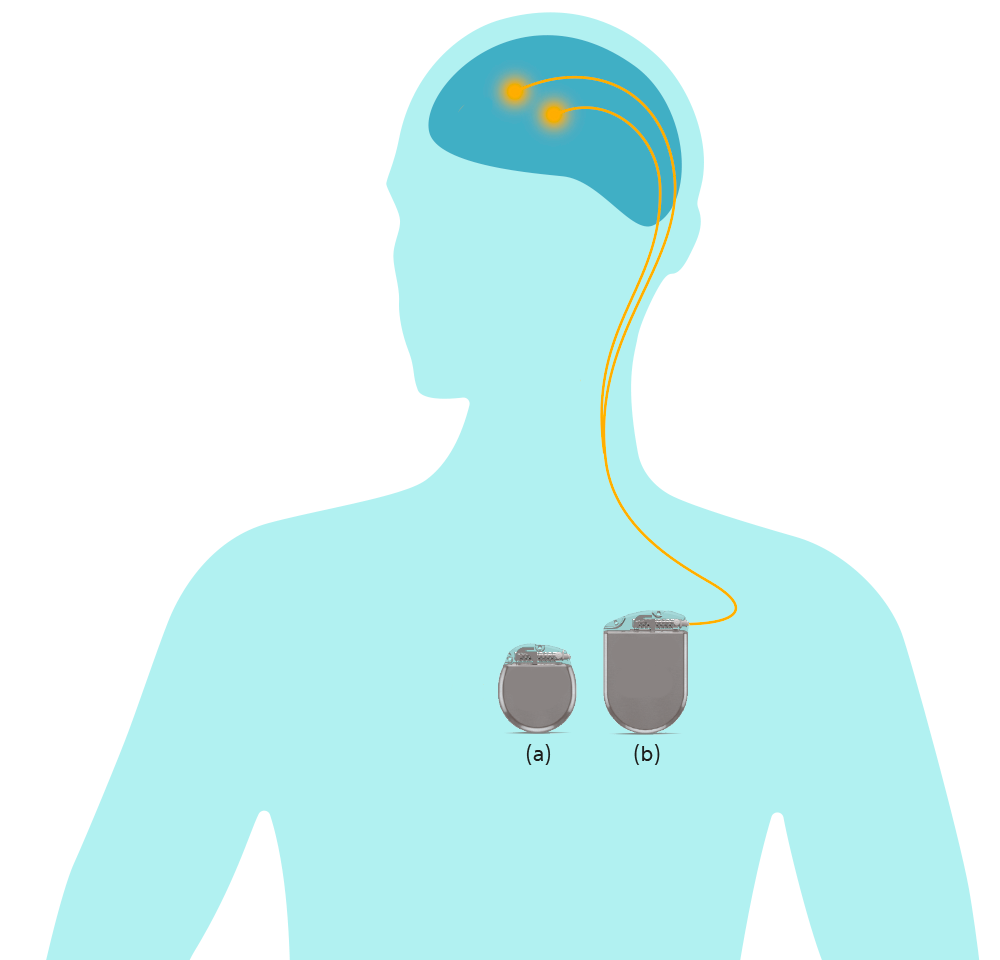
The surgeon places one or two « leads » (1) (small electrical wires that transmit the electrical stimulation from the neurostimulator to the targeted area) in targeted areas of the brain.
The leads are then connected to a rechargeable (a) or non rechargeable (b) neurostimulator. It is placed under the skin in the chest or abdomen (2) . The neurostimulator is a small electrical pulses generator. When it is powered on, it stimulates the desired parts of the brain, allowing a reduction in symptoms.
The surgical equipment is implanted inside the body and is compatible with everyday life activities (washing, bathing, work, sports, travel, etc.).
The advantage of the DBS is to be continuous, reversible and ajustable due to the possibility of vary the stimulation parameters.
DBS is not a curative treatment, but it can help improve many everyday symptoms and improve quality of life.
DBS is a surgical technique that has been in clinical use for more than 30 years and has been practiced for more than 25 years at the University Hospital of Nice.
Neurostimulator
Electrodes
Who is the procedure for?
DBS is intended for patients with certain movement disorders: Parkinson’s disease with motor fluctuations, essential tremor, dystonia, Tourette syndrome, …
It is a second-line treatment for patients whose condition is no longer controlled by drug medication.
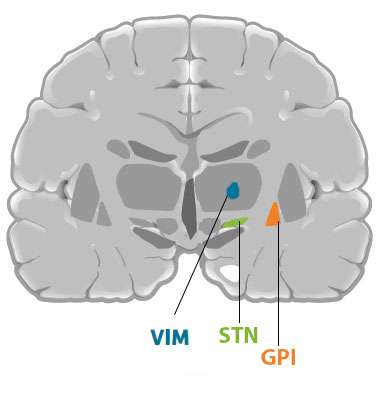
The intervention targets deep brain structures: the subthalamic nucleus (STN), the ventral intermediate nucleus of the thalamus (VIM) or the internal pallidum (GPI). The neurologist and neurosurgeon work together to determine the most suitable anatomical target for your case, based on your pathology, clinical signs, and general condition.
DBS is not indicated for the majority of Parkinson’s patients.
When to consider DBS?
At what stage of Parkinson's disease should a DBS be considered?
Many experts* agreed that a continuous treatment, such as DBS, can be considered according to the "5 and 2 or 1" rule in which : :
At least 5 doses per day of anti-Parkinsonian medication
And 2 at least 2 hours a day in OFF time
And 1 at least 1 hour a day with troublesome dyskinesias
This rule helps to identify eligibility but there are numerous other criteria to consider to validate an intervention such as: age, certain medical history and the stage of disease progression.
These criteria will be supplemented by a review of your application by a multidisciplinary team. after specific medical examinations and the opinion of your referring physician, neurologist or general practitioner.
*Source: https://pubmed.ncbi.nlm.nih.gov/30016901/
Why DBS
as a continuous treatment?
To early stages of Parkinson's disease, the drugs allow control certain symptoms in a prolonged period.
However, as the disease progresses, the duration of the effect of the medication decreases.. The increased use of medication then becomes necessary. Some people develop at this stage bothersome uncontrolled movements known as dyskinesia.
There DBS is a continuous treatment that allows you to increase your ON time (the phases when the treatment is effective) and thus improving your quality of life. DBS allows for decrease the number and the duration of the OFF times (the phases when the treatment is no longer effective) and to reduce the severity of symptoms, particularly dyskinesias.
DBS is indicated when the condition becomes disabling and resistant to conventional treatments (oral medications, botulinum toxin injections, etc.)
What are the potential benefits of DBS?
The intervention aims to alleviate the signs of your illness and improve your daily life.
Improved quality of life and autonomy
Reduction of motor fluctuations
Reduction in dyskinesias
Sleep improvement
Possible reduction in medication
The effect of DBS is not immediate and requires adjustments over several weeks or months to optimize results and fully experience the benefits. During this period, there will be appointments to fine-tune the settings and adjust the medication treatment.
Deep Brain Stimulation does not cure the disease, however it significantly improves certain symptoms and quality of life. Patients with Parkinson's disease, for example, speak of a "second wind" given by the intervention.
The disease will continue to progress gradually over the years.
The intervention aims to alleviate the signs of your illness and improve your daily life.
Improved quality of life and autonomy
Facilitating daily living activities
Pain reduction
Improvement of dystonic postures
The effect of DBS is not immediate and requires adjustments over several weeks or months to optimize results and fully experience the benefits. During this period, there will be appointments to fine-tune the settings and adjust the medication treatment.
Deep brain stimulation does not cure the disease, however it significantly improves certain symptoms and quality of life.
The intervention aims to alleviate the signs of your illness and improve your daily life.
Improved quality of life and autonomy
Tremor improvement from 70% to 80%, in average*
Less disabilities in daily life activities
The effect of DBS is not immediate and requires adjustments over several weeks or months to optimize results and fully experience the benefits. During this period, there will be appointments to fine-tune the settings and adjust the medication treatment.
Deep brain stimulation does not cure the disease, however it significantly improves certain symptoms and quality of life.
* Source : https://pubmed.ncbi.nlm.nih.gov/21256454/
What are the main constraints?
- Surgery
- For non-rechargeable neurostimulators: they need to be replaced every 3-4 years on average.
- For rechargeable neurostimulators: charge approximately once a week
- Some precautions need to be taken when undergoing MRI scans, surgical procedures, certain medical treatments, and when passing through airport security gates
And what about the risks and side effects?
During the operation or postoperative period:
- Infection (4%)
- Cerebral hemorrhage (1%)
- Pain, headaches or discomfort
- Confusion
- Phlebitis
Long-term effects after the operation:
- Wound infections may require further intervention and removal of the hardware
- Equipment malfunction
- Difficulties recharging the neurostimulator
- Decreased system efficiency over time
- Speech or vision problems, tingling sensations…
- Loss of balance
- Mood disorders
- Weight gain
Why getting your DBS surgery at the AzurDBS center in Nice?
Dedicated service and support:
Thanks to a unique organization, French and foreign patients benefit from tailored support, from the initial teleconsultation to post-operative follow-ups.
Medical and surgical team with recognized expertise:
Our multidisciplinary teams bring together neurologists, neurosurgeons, anesthesiologists, radiologists and nurses specializing in post-operative follow-ups to guarantee comprehensive and personalized care.
University Hospital Center at the Forefront
State-of-the-art surgical equipment
neurosurgical robot, intraoperative scanner, intracerebral target visualization software, electrophysiological recording of neuronal activity, advanced software for adjusting stimulation parameters
26 years
experience
The DBS practiced since 2000
A certified center by the French health authority
Parkinson's disease expert
A multidisciplinary medical environment
24/7
Setting on the French Riviera
Nice University Hospital
Pasteur Hospital 2
Nice train station
Nice Airport
Accommodation
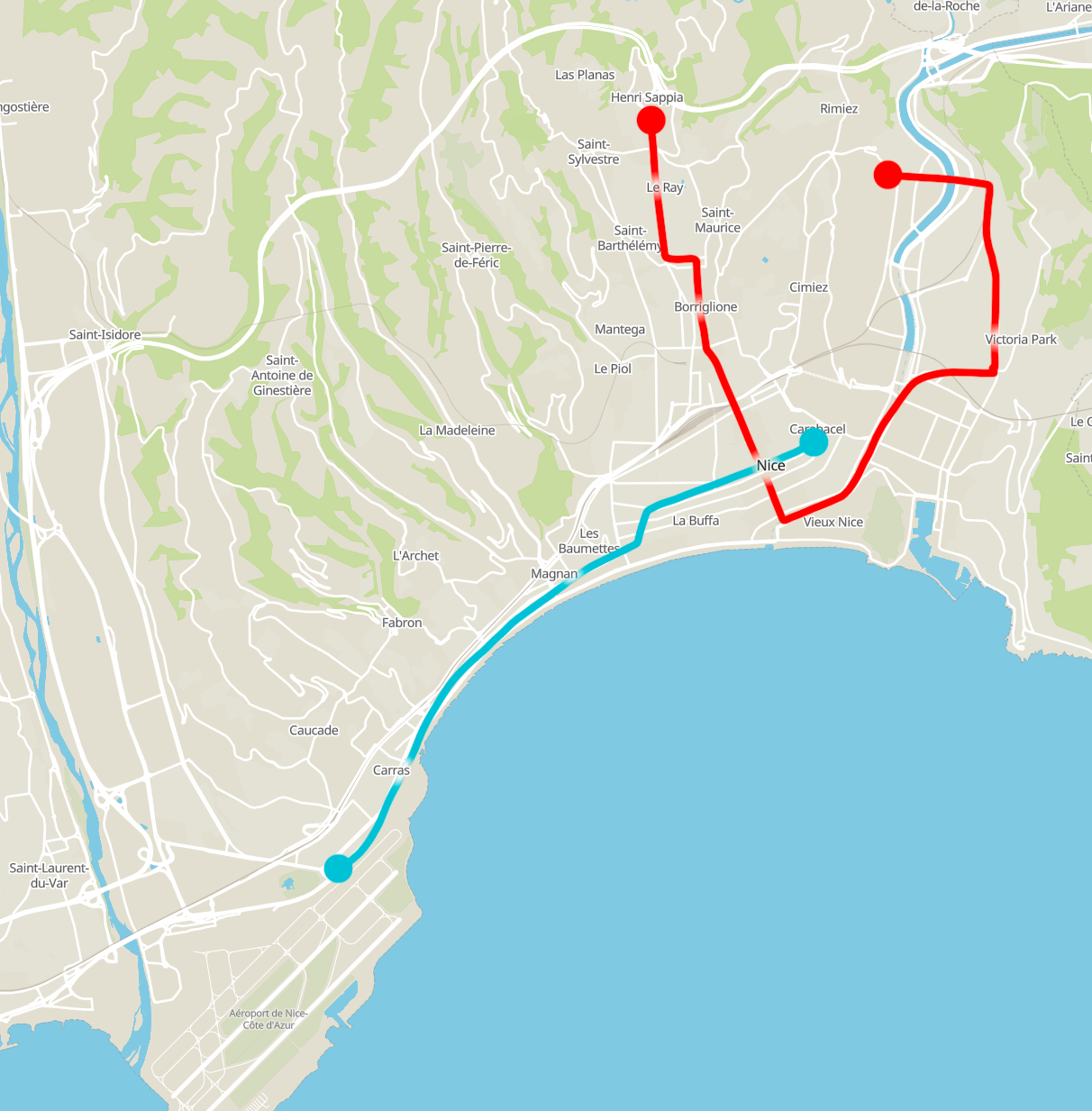
Tram line T1
Tram line T2
Crossroads stop: Jean Médecin
Nice University Hospital - Pasteur 2 Hospital
Nice train station
Novotel Vieux Nice
Appart'city Classic
City Residence Nice
City Residence Nice
Nice Airport
Line T2
Line T1
Intersection stop Jean Médecin